

A travel itinerary template helps you organize the important details of a trip in one place, including transportation, accommodation, daily activities, booking references, costs, and useful notes.
Instead of searching through emails, screenshots, and booking apps during your trip, you can use one clear document as a central reference for your plans.
This guide explains what to include in a travel itinerary, how to structure it, which format may work best for different trips, and how to build a flexible schedule without over-planning every hour.
If you are organizing your trip from the beginning, start with our step-by-step travel planning guide to work through your destination, budget, transportation, accommodation, documents, and packing before building your final itinerary.
What Is a Travel Itinerary Template?
A travel itinerary template is a reusable structure for organizing trip information. It gives you predefined sections where you can add details such as flights, hotel reservations, transportation, activities, costs, and contact information.
The template can be simple or detailed depending on your trip. A weekend break may only need a short day-by-day schedule, while a longer international trip may benefit from more detailed transportation, accommodation, and booking information.
A useful itinerary should make important information easier to find without forcing you to follow a rigid minute-by-minute schedule.
What Can a Travel Itinerary Include?
- Travel dates
- Flight, train, bus, or other transportation details
- Accommodation information
- Daily activities
- Reservation and confirmation numbers
- Addresses and contact details
- Estimated costs
- Important documents or reminders
- Emergency contact information
- Backup plans or alternative activities
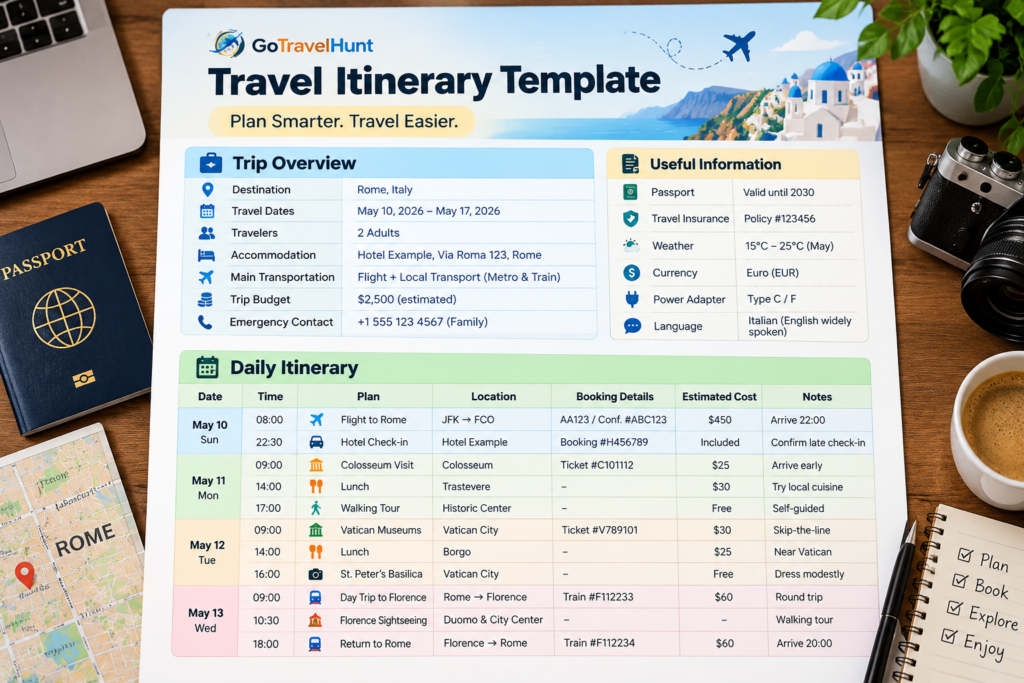
Travel Itinerary Template You Can Copy
You do not need a complicated planning system to create a useful itinerary. The following structure can be copied into Google Docs, Word, Google Sheets, Excel, or a note-taking app.
Trip Overview
| Item | Details |
|---|---|
| Destination | Add your destination |
| Travel Dates | Departure and return dates |
| Travelers | Names or number of travelers |
| Accommodation | Hotel or property details |
| Main Transportation | Flight, train, car, or bus information |
| Trip Budget | Estimated total budget |
| Emergency Contact | Name and contact information |
Daily Itinerary
| Time | Plan | Location | Booking Details | Estimated Cost | Notes |
|---|---|---|---|---|---|
| Morning | Main activity | Address or area | Reservation number if needed | Add estimate | Transport, opening time, or reminder |
| Afternoon | Main activity | Address or area | Reservation number if needed | Add estimate | Leave room for changes |
| Evening | Dinner or activity | Address or area | Reservation details if needed | Add estimate | Return transport or final notes |
You can repeat the daily section for each day of your trip.
How to Build a Travel Itinerary Step by Step
Step 1: Add Your Fixed Travel Details First
Start with the parts of the trip that are already confirmed. These normally include your main transportation and accommodation.
Add details such as:
- Departure and arrival dates
- Flight, train, or bus numbers
- Departure and arrival times
- Airport or station names
- Hotel or accommodation address
- Check-in and check-out times
- Booking references
- Contact details for the provider
Keeping these details together makes them easier to find when you are traveling.
Step 2: Divide the Trip Into Days
Create a separate section for each day of the trip. Start with the activities that already have fixed times, such as tours, tickets, reservations, events, or transportation.
Then add optional activities around those fixed commitments.
A useful itinerary should show the general flow of the day without making every hour mandatory.
Step 3: Include Travel Time Between Activities
One of the easiest itinerary mistakes is planning activities without considering how long it takes to move between them.
When comparing your daily plans, include time for walking, public transportation, driving, parking, security checks, queues, and other realistic delays.
Leaving buffer time between major activities can make the itinerary more practical and easier to adjust if something takes longer than expected.
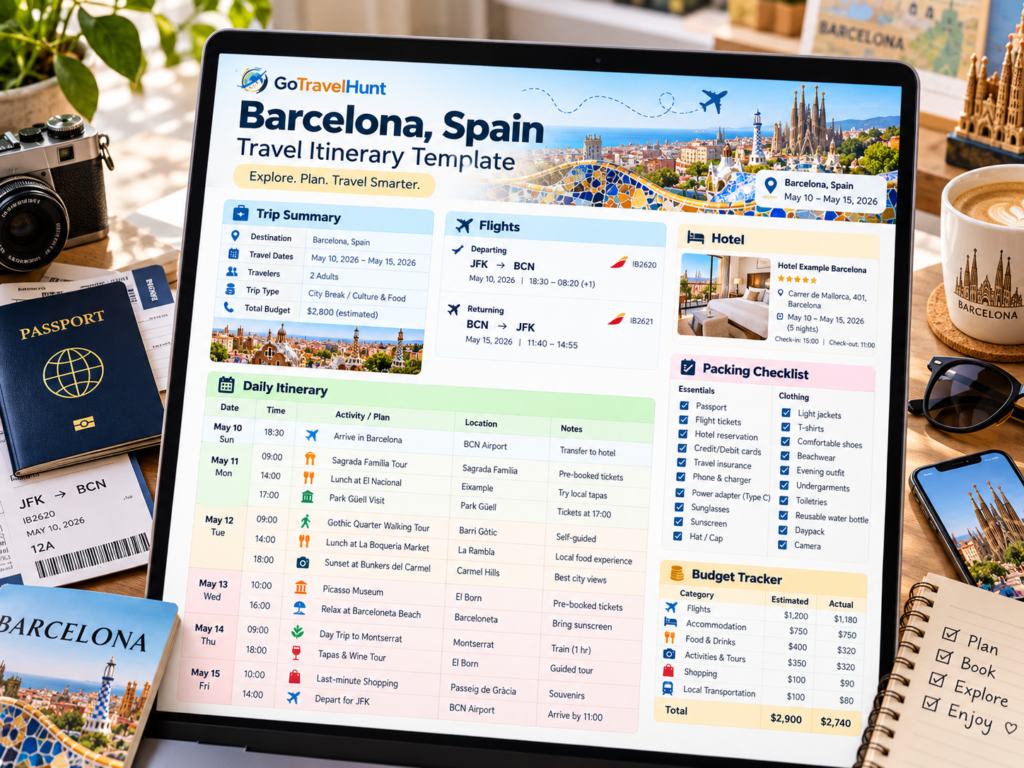
Step 4: Add Estimated Costs
Your itinerary can also act as a simple trip-budget tracker.
Add estimated costs for:
- Transportation
- Accommodation
- Attractions and tours
- Meals
- Local transportation
- Parking
- Tickets
- Other planned expenses
This does not need to be an exact accounting system. The purpose is to help you see how your daily plans fit within the overall trip budget.
Step 5: Add Important Notes and Backup Options
Add any information that may be useful during the trip, such as opening hours, reservation instructions, local transportation notes, meeting points, or alternative activities.
It can also be useful to include a backup option for activities that depend on weather, availability, or opening conditions.
What Information Should Be Included in a Travel Itinerary?
Transportation Details
Record the information you may need while traveling, including departure times, arrival times, terminals or stations, booking references, and transportation provider details.
If you are comparing flights before completing your itinerary, our flight fare finder guide explains how to compare airfares, baggage, stops, booking providers, and total trip cost.
Accommodation Details
Include the accommodation name, address, check-in and check-out dates, reservation number, and a contact method.
If you are staying in more than one property, list each accommodation under the relevant travel date.
Activities and Reservations
For pre-booked attractions, tours, restaurants, or events, include the reservation time, location, booking reference, and any instructions you may need.
For activities that do not require reservations, you can simply add them as optional items instead of assigning a strict time.
Important Contacts
Depending on the trip, your itinerary may include useful contact information for accommodations, transportation providers, travel companions, insurance providers, or personal emergency contacts.
For international travel, verify local emergency information and relevant official contact details for your destination before departure.
Travel Documents and Reminders
You can use the itinerary as a reminder of the documents you need, but avoid storing highly sensitive personal information in an unsecured document.
For a broader packing and preparation list, see our travel items checklist.
How Detailed Should a Travel Itinerary Be?
The right amount of detail depends on the type of trip and your planning style.
A short weekend getaway may only require transportation details, accommodation information, and a few planned activities. A longer or more complicated trip may need a more detailed itinerary with multiple transportation bookings, hotels, reservations, and daily logistics.
The goal is not to schedule every minute. A useful itinerary provides enough structure to keep important plans organized while leaving room for delays, rest, spontaneous activities, and changes.
Choosing the Right Travel Itinerary Format
Google Docs or Microsoft Word
A document format works well if you want a simple itinerary that combines schedules, notes, addresses, links, and booking information.
It is particularly useful for travelers who prefer reading the itinerary as a document rather than managing rows and columns.
Google Sheets or Microsoft Excel
A spreadsheet can be useful when you want to organize your trip by date, time, cost, transportation, and booking details.
Spreadsheets are also helpful if you want to calculate estimated expenses or share a structured schedule with other travelers.
Mobile Notes or Planning Apps
A mobile note or travel-planning app can be convenient for accessing your itinerary while moving between locations.
Before relying on any app during a trip, consider whether the information will still be available if you temporarily lose internet access.
Printable Itinerary
A printed copy can serve as a simple backup for essential details such as transportation, accommodation addresses, and important contact information.
You do not necessarily need to print your entire itinerary. A shorter version containing the most important information may be enough.
Travel Itinerary Templates for Different Types of Trips
Weekend Getaway
Keep the itinerary simple. Focus on transportation, accommodation, one or two main activities per day, and dining or reservation details.
If you are still deciding where to go, you can also explore our weekend getaway guide.
Family Vacation
A family itinerary may need additional coordination for multiple travelers. Include transportation, meal plans, reservations, rest periods, and any important needs that affect the schedule.
A shared itinerary can help everyone understand the main plan without requiring each person to track separate booking information.
Group Trip
For group travel, include meeting points, shared reservations, transportation arrangements, and clear times for activities that everyone needs to attend.
Use a shared document if several people need access to the most recent version.
Business Trip
A business-travel itinerary may include meetings, addresses, contact details, transportation between appointments, accommodation information, and time reserved for preparation.
International Trip
International itineraries often benefit from additional information such as terminal details, local transportation, accommodation addresses, important contact information, and reminders about required documents.
Entry and visa requirements vary by destination and traveler. Always verify current requirements with the relevant embassy, consulate, immigration authority, or other official source before travel.
Can a Travel Itinerary Be Used for a Visa Application?
Some visa applications may ask for travel plans, accommodation information, transportation reservations, or an itinerary as part of the supporting documentation.
However, requirements vary significantly between countries, visa types, consulates, and individual applications.
Do not assume that one travel itinerary format will meet every visa requirement. Check the official instructions for the specific visa you are applying for before preparing or purchasing travel arrangements.
If an itinerary is requested, it may need information such as:
- Intended travel dates
- Destinations or cities you plan to visit
- Accommodation details
- Transportation plans
- A general day-by-day schedule
Only include information that accurately reflects your intended plans.
Common Travel Itinerary Mistakes to Avoid
Over-Scheduling Every Day
Trying to fill every hour can make the itinerary difficult to follow and leave little room for unexpected delays or changes.
Choose the most important activities first, then leave some flexible time around them.
Ignoring Transportation Time
Two attractions may look close on a map but still require additional time for walking, public transportation, parking, queues, or transfers.
Include realistic travel time between important activities.
Choosing Too Many Distant Activities on the Same Day
Group nearby activities together when possible. This can reduce unnecessary transportation and make the day easier to manage.
Not Checking Opening Times or Reservation Requirements
Before finalizing your itinerary, verify the current opening hours and reservation requirements for the places you plan to visit.
Time-sensitive information can change, so check it again close to your travel date.
Depending on Only One Copy of the Itinerary
If your entire plan is stored only on one device, you may have difficulty accessing it if the device is unavailable.
Consider keeping an offline or printed copy of the most important travel information.
Forgetting to Update the Itinerary
If a flight, hotel, activity, or reservation changes, update the itinerary so you are not relying on outdated details during the trip.
How to Keep Your Itinerary Flexible
A good itinerary should provide structure without becoming restrictive.
One practical approach is to divide activities into three groups:
- Fixed: Flights, trains, tours, reservations, or events that have a specific time.
- Preferred: Activities you would like to do but can move to another time.
- Optional: Extra ideas to use if you have free time.
This makes it easier to adjust your plans if the weather changes, transportation is delayed, or you decide to spend more time somewhere than expected.
Frequently Asked Questions About Travel Itinerary Templates
What is the difference between a travel plan and a travel itinerary?
A travel plan usually describes the broader structure of a trip, such as the destination, dates, budget, and general goals.
A travel itinerary is more detailed and normally organizes specific transportation, accommodation, reservations, and daily activities.
Do I need a travel itinerary for every trip?
No. A simple trip may only require basic booking information. An itinerary becomes more useful when the trip includes multiple bookings, destinations, travelers, or activities that need to be coordinated.
Should I make my itinerary before booking flights and hotels?
You can create a rough itinerary before booking to compare your options. After confirming transportation and accommodation, update the itinerary with the final booking details.
Should I use a digital or printed itinerary?
A digital itinerary is easier to update and share. A printed or offline copy can provide a useful backup for important information.
You can use both rather than choosing only one format.
How far in advance should I create my itinerary?
There is no universal deadline. Start once you know your destination and approximate travel dates, then add details as bookings and plans become confirmed.
What should I avoid putting in a shared itinerary?
Avoid storing unnecessary sensitive personal information, payment details, passwords, or full copies of confidential documents in a document that may be widely shared.
Final Thoughts
A travel itinerary template can make trip planning easier by keeping important information organized in one place.
Start with confirmed transportation and accommodation, divide the trip into days, add realistic travel time, record important reservations, and leave room for flexibility.
The best itinerary is not necessarily the most detailed one. It is the one that helps you quickly find the information you need while still allowing the trip to change when necessary.
For the rest of your preparation, use our complete travel planning guide to organize your budget, documents, transportation, accommodation, and pre-trip checks.