
Travel insurance compare: Top 4 Smart Choices
Why Every Traveler Needs to Master Travel Insurance Compare
Travel insurance compare is the essential first step to protecting your trip investment and your peace of mind. When you compare policies side-by-side, you can quickly identify which plan offers the best coverage for your specific needs—whether that’s comprehensive medical protection, trip cancellation benefits, or specialized coverage for adventure activities.
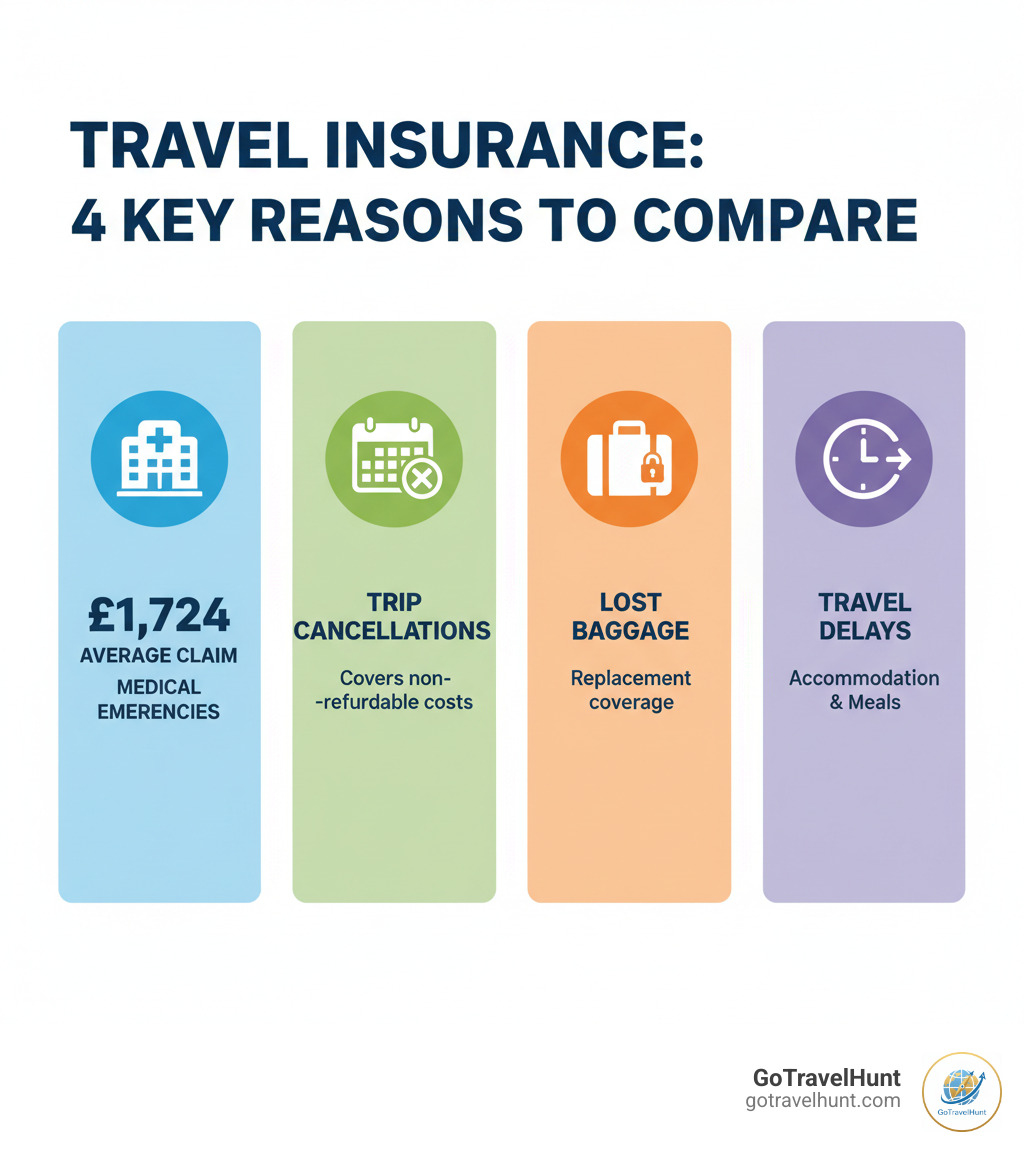
To effectively compare travel insurance, focus on key elements like coverage types, policy limits, exclusions, premium cost, and provider reputation. The numbers tell a compelling story: according to industry data, 574,000 travel insurance claims were made in 2023, totaling £511 million. The average emergency medical claim alone was £1,724, and serious incidents can cost hundreds of thousands.
Despite these risks, the Association of British Travel Agents (ABTA) found that nearly half of travelers still go unprotected. The Australian Government’s Smartraveller website states travel insurance is “as important as a passport” when heading abroad. The challenge isn’t whether to buy it, but finding the right policy without overpaying. Modern comparison tools make it possible to evaluate dozens of policies in minutes, filtering by your needs and budget.
I’m Ramy Saber, and through my work with GoTravelHunt, I’ve helped countless travelers understand how to travel insurance compare effectively. My background in risk assessment has given me a keen eye for the coverage details that matter most for stress-free travel.
Simple guide to travel insurance compare:
Why Comparing Travel Insurance is Your First Smart Travel Decision
Imagine planning your dream European adventure, only to have a sudden illness force you to cancel, losing thousands in non-refundable bookings. This is precisely why learning to travel insurance compare should be your first planning step, not an afterthought. Think of it as an invisible safety net protecting your investment and health.
Unexpected events—a family emergency, severe weather, lost luggage, or a medical crisis—can turn a dream trip into a financial disaster. This isn’t about being pessimistic; it’s about being prepared. When you travel insurance compare policies, you’re making a smart investment in peace of mind, ensuring that if something goes wrong, you won’t spend years recovering financially.
Understanding Different Plan Types
Not all policies are the same, and choosing the right type is key. When you travel insurance compare, you’ll find several main options:
Single trip policies are for one-off vacations. They cover you from the moment you leave until you return, making them perfect if you travel once or twice a year.
Annual multi-trip policies are ideal for frequent travelers. One purchase covers unlimited trips within a year (though individual trips are often capped at 31 days), which is usually more cost-effective than buying separate coverage each time.
Here’s how they compare:
| Feature | Single Trip Insurance | Annual Multi-Trip Insurance |
|---|---|---|
| Coverage Period | One specific trip | Multiple trips within 12 months |
| Cost | Can be cheaper for a single, long trip | More cost-effective for frequent travelers |
| Convenience | Purchase per trip | Buy once, cover all trips |
| Ideal For | Unique, longer, or less frequent travel | Regular, shorter trips |
| Max Trip Length | Varies, often up to 365 days | Typically 31 days per trip (can be upgraded) |
Specialized policies also exist. Family plans bundle everyone together, often with child-specific benefits. You can learn more in our guide to Travel Insurance for Children. Backpacker insurance covers longer journeys, while cruise insurance addresses unique risks like missed port calls and shipboard medical emergencies.
Travel Medical vs. Trip Cancellation Insurance
Understanding these two components is crucial when you travel insurance compare. They form the backbone of most comprehensive policies but serve different purposes.
Travel medical insurance is your health safety net abroad, as your domestic health plan likely offers little to no coverage internationally. Trip Medical Insurance covers unexpected medical costs like doctor visits, hospital stays, and, critically, emergency medical evacuation. This can transport you to an adequate facility or back home, saving you from bills that can reach six figures.
Trip cancellation and interruption insurance protects your financial investment. Travel Cancellation Insurance reimburses your prepaid, non-refundable expenses if you must cancel before your trip for a covered reason (like illness or a family emergency). Trip interruption covers you after departure, reimbursing unused portions of your trip and extra costs to return home early. Most comprehensive policies bundle both, which we highly recommend for any significant trip.
Decoding the Policy: Key Coverage to Compare Side-by-Side
Now for the detective work: understanding what you’re buying. Spending fifteen minutes now could save you thousands later. When you travel insurance compare, the premium is just the start. A cheaper policy might offer significantly lower coverage limits, making a slightly more expensive plan a much better value.
Focus on these critical elements: scrutinize the policy details for what’s covered, examine the coverage limits (how much the insurer pays), and check the deductible (what you pay first). Don’t overlook the fine print, as exclusions and limitations buried in legal language determine what’s actually covered. Finally, consider the provider’s reputation—a policy is only as good as the company that backs it.
Essential Medical and Evacuation Coverage
This is the coverage that can save your life and your finances. For international trips, we recommend a minimum of $50,000 for emergency medical treatment, but $100,000 or more is safer, as costs for hospital stays, surgery, and even dental emergencies can escalate quickly.
The most critical benefit is medical evacuation. If you’re seriously injured in a remote area, this covers transporting you to a better-equipped facility or back home. These evacuations can cost over $100,000, so look for coverage limits of at least $250,000. Finally, repatriation of remains covers the high cost of bringing a deceased person home, sparing grieving families an additional financial burden. Never compromise on medical coverage to save a few pounds.
Trip Protection: Cancellation, Interruption, and Delays
Protecting your financial investment is just as important as protecting your health.
- Trip Cancellation/Interruption: This reimburses your non-refundable costs if you must cancel before your trip or cut it short for a covered reason, like an unexpected illness or family emergency. It also covers the cost of last-minute flights home.
- Travel Delay & Missed Connections: If your flight is delayed for a specified period (usually 6-12 hours), this benefit covers reasonable expenses like meals and accommodation. Missed connection coverage helps with rebooking if a delay causes you to miss a connecting flight.
- Baggage Loss & Delay: This provides reimbursement for essential items if your bags are delayed and reimburses you up to the policy limit if they are lost or stolen entirely. High-value items often have sub-limits.
These protections ensure that unexpected problems don’t derail your budget.
Optional Upgrades: ‘Cancel For Any Reason’ (CFAR) and Pre-Existing Conditions
Sometimes, standard coverage isn’t enough. That’s where optional upgrades come in.
‘Cancel For Any Reason’ (CFAR) offers ultimate flexibility, letting you cancel for any reason not covered by a standard policy. You’ll typically get 75% reimbursement instead of 100%, but it must be purchased within a specific window (usually 10-21 days) of your initial trip deposit.
Pre-existing medical conditions are a major concern, as most standard policies exclude them. To get coverage, you often need a waiver, which requires purchasing the policy shortly after your initial trip deposit. Your condition must also be “stable” during a look-back period (60-180 days), as defined by strict stability clauses. For complex conditions, specialist providers may be necessary; MoneyHelper has a directory of specialist providers. Always be completely honest about your medical history to avoid denied claims.
Your Step-by-Step Guide to Travel Insurance Compare
Now that we’ve covered the “what” and “why,” let’s get to the “how.” Modern comparison platforms have transformed this process, allowing you to evaluate dozens of policies in minutes.

How to Effectively Travel Insurance Compare
Using a reputable comparison website is the smartest approach. They gather quotes from multiple providers and present them side-by-side for an informed decision.
- Enter Your Trip Details: Accurately provide your destination, total non-refundable trip cost, traveler ages, and travel dates. Be transparent about any pre-existing medical conditions and planned high-risk activities (like skiing or scuba diving).
- Filter and Compare Quotes: Once quotes appear, use the filter options to narrow choices based on your needs (e.g., medical coverage over €1,000,000, CFAR inclusion). Compare the prices and key benefits of different policies.
- Read the Full Policy: Don’t just stop at the summary. Always read the full policy wording (PDS). This document contains the exact terms, conditions, and exclusions that determine if you’re covered.
- Check Provider Reputation: Look at customer ratings on platforms like Trustpilot. Genuine feedback from other travelers, especially regarding the claims process, is invaluable. You’re not just looking for the cheapest option, but the best value.
Factors That Influence Your Insurance Premium
Understanding what drives your policy’s cost helps you make smarter decisions. When you travel insurance compare, you’ll see premiums vary based on several factors.

- Traveler Age: Older travelers generally pay more due to a higher statistical likelihood of medical emergencies.
- Trip Duration: Longer trips mean more risk, so they cost more to insure.
- Destination Risk: Traveling to countries with high healthcare costs or greater instability will increase your premium.
- Total Trip Cost: The higher your non-refundable trip cost, the higher the premium, as the insurer’s potential payout is larger.
- Level of Coverage: Comprehensive policies with high limits and optional add-ons cost more than basic, medical-only plans.
As a rule of thumb, expect to spend 4% to 10% of your total trip cost on comprehensive insurance. The best value is the policy that covers your needs at a competitive price.
When to Purchase Your Policy
Timing is everything. The golden rule is: buy your travel insurance immediately after booking your trip (i.e., after paying your first non-refundable deposit).
Why the urgency? Several valuable, time-sensitive benefits are only available if you purchase within a specific window, typically 10-21 days after your initial trip payment. These include:
- Pre-existing Condition Waiver: Many policies waive exclusions for pre-existing conditions only if you buy early.
- ‘Cancel For Any Reason’ (CFAR) Eligibility: This valuable upgrade is almost always an early-purchase benefit.
- Financial Default Coverage: Protection if your tour operator or airline goes out of business is often only included if you buy your policy promptly.
Buying early also ensures you’re covered for unexpected events that happen before your departure. Don’t fall into the “I’ll do it later” trap—make it part of your booking process.
Navigating Exclusions, Fine Print, and Special Cases
Even the most comprehensive policy won’t cover everything. Understanding what’s not included is just as crucial as knowing what is. When you travel insurance compare, look for these common exclusions to avoid surprises.

Policies are designed for unforeseen events. They generally won’t cover:
- High-Risk Activities: Standard policies often exclude sports like skiing or bungee jumping unless you buy an add-on. For skiing, you’ll need Winter Sports Travel Insurance.
- Alcohol and Drug-Related Incidents: Injuries or losses sustained while under the influence are almost universally excluded.
- Undeclared Pre-existing Conditions: Failing to disclose a health condition can invalidate your policy. Honesty is essential.
- Foreseeable Events: Traveling against government advisories or to a destination with a known natural disaster risk (like an erupting volcano) may void your coverage.
- Negligence: Leaving your belongings unattended could result in a denied theft claim.
Considerations for Different Travelers
Your insurance needs depend on who you are and how you travel.
- Seniors: May face higher premiums and stricter rules on pre-existing conditions, but many specialist policies offer excellent comprehensive coverage for older travelers.
- Students: Those on gap years or studying abroad need long-duration policies that may cover academic disruptions.
- Adventure Travelers: Require add-ons for hazardous sports. Standard policies won’t cover hiking in the Alps or scuba diving without specific upgrades.
- Business Travelers: An annual multi-trip policy with coverage for business equipment and schedule disruptions is often the most practical choice.
- One-Way Travelers: If you’re relocating or starting an open-ended journey, you’ll need specialized coverage detailed in our One Way Travel Insurance Complete Guide.
Domestic vs. International and Destination-Specific Rules
Where you’re going significantly impacts your coverage needs.
Domestic travel insurance primarily focuses on trip cancellation, lost baggage, and travel delays, as your regular health insurance typically covers medical emergencies within your home country.
International travel insurance is different. Your domestic health plan likely offers little to no coverage abroad, making robust international medical coverage paramount. Even in Europe, you may not be entitled to free care as a tourist.
For the Schengen Area, non-EU/EEA citizens may need to show proof of insurance with at least €30,000 in medical coverage to get a visa. British travelers should check GOV.UK for Schengen rules for current requirements. Our European Travel Insurance guide explores this further. Always check government travel advisories before your trip, as traveling against official advice can invalidate your policy.
Frequently Asked Questions about Comparing Travel Insurance
It’s natural to have a few lingering questions. Here are answers to what we hear most often from travelers when they travel insurance compare.
How does the claims process work?
Knowing the process can reduce stress during an emergency. Here are the key steps:
- Contact Your Provider Immediately: Use their 24/7 emergency assistance line. They will guide you on what to do next, whether it’s finding an approved hospital or filing a police report for theft.
- Document Everything: This is crucial. Keep all receipts, medical reports, police reports, and booking confirmations. The more evidence you have, the smoother your claim will be.
- Submit Your Claim: Most travel insurance works on a reimbursement basis, meaning you pay upfront and submit your claim with all documentation to get your money back. For major medical emergencies, the insurer may arrange direct payment with the hospital.
Stay organized, keep everything, and communicate promptly with your insurer.
How do customer reviews and provider reputation factor in?
The cheapest policy isn’t always the best. When you travel insurance compare, you’re choosing a partner for a crisis.
- Customer Reviews: Platforms like Trustpilot offer invaluable insight into how an insurer handles claims. Pay attention to comments about the claims process—was it fast and fair, or a bureaucratic nightmare? Good customer service is critical in an emergency.
- Financial Strength: Ratings from agencies like A.M. Best indicate if a company is financially stable enough to pay claims. A highly-rated insurer provides more security.
A policy from a company with terrible reviews isn’t a bargain. Look for insurers with a solid track record for your peace of mind.
Do I need travel insurance if I have a GHIC/EHIC card?
Yes. A Global Health Insurance Card (GHIC) or European Health Insurance Card (EHIC) is helpful, but it is not a substitute for proper travel insurance.
Your card entitles you to state-provided healthcare in EU countries at the same cost as a resident. However, it has significant gaps. Your GHIC/EHIC does not cover:
- Private medical treatment
- Trip cancellation or interruption
- Lost or stolen baggage and belongings
- Travel delays
- Emergency medical evacuation or repatriation to get you home
The last point is critical, as evacuation can cost hundreds of thousands of pounds. The GOV.UK guidance on GHIC is clear: you should still have travel insurance. Think of your card as a bonus for basic medical care, while a comprehensive policy provides true protection for your trip and finances.
Conclusion: Travel with Confidence
You’re now equipped to make an informed decision that will protect both your trip and your peace of mind. Taking the time to travel insurance compare properly isn’t just a task—it’s building a safety net that lets you explore without the nagging worry of “what if?”
The best travel insurance isn’t the cheapest or most expensive. It’s the one that offers the best value by matching your specific needs—your destination, activities, health, and budget. By reading the policy, checking reviews, and understanding the exclusions, you can find the right balance of comprehensive coverage and cost.
Most importantly, buy your policy right after booking your trip to open up valuable, time-sensitive benefits. This simple step ensures you’re protected from day one.
At GoTravelHunt, we’re passionate about making travel planning easy and stress-free. We provide guides and tools to help you create unforgettable journeys. If Australia is on your list, don’t miss our guide to Find the best travel insurance for your Australian adventure.
Your dream trip awaits. Now that you know how to travel insurance compare effectively, you can book with confidence. Go ahead and pack your bags, knowing you’ve protected your investment and your well-being.